A flash of sunlight from a window can catch your eye, while the light reflected by the grass below it usually goes unnoticed. In measurements taken by researchers from Heriot-Watt University and Edinburgh Napier University, grass reflected around a quarter of the sunlight it received. This proportion is known as albedo and can be expressed as a decimal or a percentage. For the grass they measured, the average was 24%.
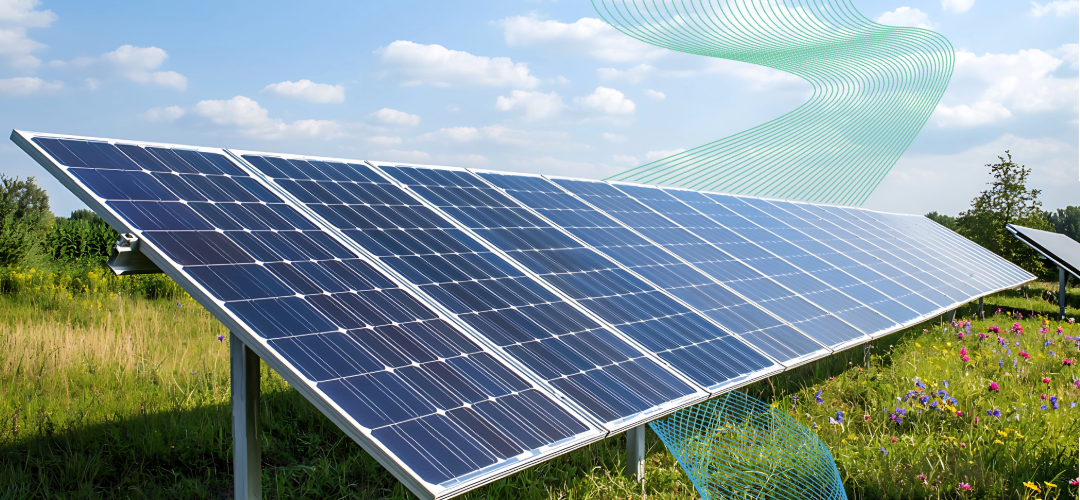
Grass scatters reflected light in many directions, while a smooth pane of glass can direct it towards a particular spot. The same principle matters when designing a solar park, where even a small amount of light reflected from the panels can appear bright to someone in its path. A glint and glare assessment looks at whether those reflections could reach nearby homes or stretches of road, and when and for how long they might be visible as the sun’s position changes throughout the day and across the seasons.
Why reduce reflections?
The solar cells that generate electricity sit behind a protective layer of glass. Research published in Surface and Coatings Technology estimates that around 4% of incoming light reflects off the outer surface of uncoated glass under particular conditions. Manufacturers use anti-reflective coatings to reduce that loss and allow more sunlight to reach the cells.
What does albedo tell us about glare?
Albedo measures how much sunlight a surface reflects overall, while the brightness of a reflection seen from a particular spot also depends on how concentrated that light is. Research by Sandia National Laboratories found that the texture of solar panel glass affects how widely reflected light spreads, and a review of solar PV glare assessments explains how the angle at which sunlight hits a panel affects how much light it reflects. Even a small share of incoming sunlight can appear bright to someone in the path of the reflection.
When can glint and glare occur?
Glint is a brief flash of reflected light, while glare is a more sustained brightness. Whether someone experiences either depends on the position of the sun, the angle of the panels and where the person is viewing them from.
In Australia, New South Wales guidance for large-scale solar projects says glint and glare typically occur for short periods under specific geometric and atmospheric conditions. In Germany, guidance from the federal and state working group on emissions control highlights nearby properties to the east or west of an installation as locations that may warrant closer assessment.
How are reflections assessed at a solar park?
For Nationally Significant Infrastructure Projects (NSIPs) in England, the National Policy Statement for renewable energy infrastructure asks applicants to identify locations that could be affected by reflections. Where a detailed assessment is needed, it considers the angle, duration and intensity of those reflections.
Published planning documents show how glare is considered in other markets where Elements Green works. In Italy, the proposed Manimuzzi agrivoltaic project in Puglia has a dedicated glare study. In Spain, a published environmental decision in Castilla-La Mancha discusses a glare assessment that considered a nearby residential development in Yeles.
At Elements Green’s Great North Road Solar and Biodiversity Park (GNR), the glint and glare assessment modelled potential reflections at homes, along roads and railways, and at locations relevant to aviation. For fixed observation points, it compared how long glare could occur under continuous sunshine with estimates based on typical sunshine levels. For road and rail users and aircraft, the assessment criteria focused on the intensity of the reflection.
The June 2025 assessment found that predicted effects at all assessed residential properties were below the relevant criteria. It also identified potential glare effects on certain sections of the A1, A616 and A617, where further mitigation will be required. No exceedances of the relevant assessment criteria were identified for the East Coast Main Line.
The findings have already influenced the project design. An earlier assessment identified one residential property where predicted glare exceeded the relevant criteria. In response, Elements Green reduced the area of solar panels closest to that property.
Where modelling identifies a potential impact, the design team can consider measures such as adding screening or adjusting the layout or angle of the panels. At GNR, potential measures also include using textured glass in specific areas. The detailed mitigation scheme will be developed to reflect the final solar panel design, in consultation with relevant stakeholders, and submitted for approval before construction.
Where modelling identifies a potential impact, the design team can consider measures such as adding screening or adjusting the layout or angle of the panels. A 2026 international review of glare from building-integrated solar found that assessment methods vary between countries and highlighted the value of considering glare early in the design process.
Considering glint and glare early gives designers more room to respond to the surroundings of each solar park. In practice, that might mean adjusting the angle of a row of panels or using a hedgerow to screen a particular view, so the project can make good use of the sunlight available while taking account of the people who live and travel nearby.
At Elements Green, this is an important part of our approach to responsible project development. By assessing potential reflections, responding to the findings and considering appropriate mitigation, we aim to minimise impacts on nearby communities and transport routes.