What happens to a solar panel when it is damaged, replaced or eventually reaches the end of its working life?
It is a question the renewable energy industry needs to answer clearly. For Elements Green, it is also something we want to understand well before our projects need these services at scale.
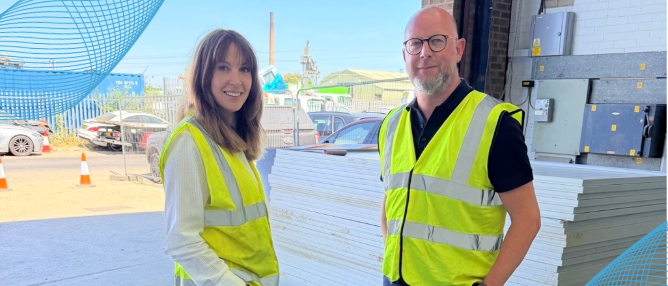
That is why our team recently visited Solar Recycling Solutions, SRS, at its specialist facility in Swanscombe, Kent. SRS specialises in recovering materials from solar panels. During our visit, CEO Bryan Hughes took us through the recycling process, the technology behind it and the work his team is doing to recover more value from each panel.
The figure that stood out was 99%.
SRS demonstrated that silicon-based solar panels can be up to 99% recyclable. Bryan showed us that glass, aluminium, silicon, copper and other metals can all be separated and recovered.
Recycling starts long before decommissioning
For a proposed project such as Great North Road Solar and Biodiversity Park, large-scale decommissioning would be decades away. The project is being developed around a 40-year operational period – but lifecycle planning cannot wait 40 years.
Individual panels can be damaged or develop faults during operation. Weather events, accidental damage or equipment failure can mean panels need to be removed and replaced well before a solar park itself reaches the end of its operational life.
For us, that means identifying responsible recycling routes now.
Our visit to SRS showed what a UK-based solution can look like. We are taking the same approach internationally and exploring local recycling options for our projects.
The aim is straightforward. Where material does need to leave one of our sites, we want to understand where it goes, how it is processed and how much can be returned to productive use.
What happens to a panel?
Solar panels contain several materials with established recycling value.
At SRS, the process begins by dismantling the panel. Aluminium framing, junction boxes and cabling are removed before the remaining layers are separated and processed.
Glass forms a major part of the panel. Aluminium can be returned to the metals recycling stream, while silicon and metals including copper and silver can undergo further separation and processing. SRS explains its recycling process here.
This is an area where technology continues to develop. During our visit, Bryan and the team talked us through the research taking place to improve separation techniques and recover an even greater proportion of useful material, including SRS’s work with researchers at the University of Bath to explore heat-based methods that could help separate the glass from the underlying layers of a solar panel. That focus on continuous improvement aligns closely with Elements Green’s ethos.
SRS is not treating 99% as the finish line. Its team is looking at how processes can improve further as recycling technology develops and volumes increase.
Solar panels are covered by UK recycling rules
There is also an established regulatory framework. Photovoltaic (PV) panels have been covered by the Waste Electrical and Electronic Equipment Regulations 2013 since 2014. The regulations place responsibilities on producers to finance the collection, treatment, recovery and environmentally sound disposal of electrical equipment when it becomes waste.
Historic England’s guidance on PV recycling also confirms that solar panels fall within the WEEE regime and that end-of-life recycling should be considered when planning a PV system. It notes that 90% of glass and 95% of semiconductor materials can be recycled using established processes. Read Historic England’s guidance on end-of-life PV recycling.
The important distinction is that 99% is not a universal recycling rate for every panel or every recycling process.
It is the recovery rate SRS says it can achieve for the silicon-based panels its process is designed to handle. Wider recovery rates depend on panel design, technology and the recycling process used.
That context matters. It also shows how quickly specialist recycling capability is developing.
Building relationships before we need them
Alex Kinnear-Mellor, Head of Corporate Affairs at Elements Green, said: “Bryan and the SRS team were generous with their time and knowledge. Seeing the process first-hand was valuable because it showed us what is already possible here in the UK.
“The headline figure is striking. SRS says it can recycle up to 99% of a silicon-based solar panel, while continuing to look at ways of recovering even more value from the materials.
“Our projects are being developed for decades of operation, so large-scale end-of-life recycling is a long way into the future. But individual panels can still be damaged or need replacing during that time. We want responsible recycling routes in place before we need them.
“Relationships like this help us build that knowledge now. We are taking the same approach internationally, looking at recycling solutions within the markets where we develop projects.”
Solar recycling will continue to change as technology improves and greater volumes of panels eventually reach the end of their working lives.
For Elements Green, the important work starts earlier.