UK – Like many across the renewable energy sector, we see rooftop solar as an important part of meeting both net zero targets and nations’ energy security challenges. But scale matters, for example, the UK government’s Solar Roadmap, published in June 2025, targets 45 to 47 GW of installed solar capacity by 2030, compared with 18 GW in the first quarter of 2025.
Under the Roadmap’s illustrative Current Policy scenario, around 60% to 65% of installed capacity could come from large-scale projects. Around 20% could come from domestic rooftops, with a further 15% to 20% from commercial rooftops and smaller ground-mounted schemes. At the high end of this scenario, the Government estimates that solar would use up to 0.4% of total UK land.
The Government’s Solar Roadmap therefore treats rooftop and large-scale solar as complementary parts of the same deployment challenge. Both will need to grow if the UK is to meet its 2030 ambition.
The evidence for that combined approach keeps building. According to analysis by the energy think tank Ember, solar provided a quarter of the European Union’s electricity in June 2026, the first time it has done so over a full month. Solar generated a record 52 TWh, making it the EU’s largest single source of power for the month, ahead of nuclear, gas, wind and hydro. That milestone reflects the rapid pace of solar deployment across Europe.
Closer to home, one announcement stands out: the Department for Education’s plan, published on 16 July, to widen access to solar across England’s schools and colleges.
What the DfE announced
So far, 245 schools and colleges in England have received government-funded solar panels through the Great British Energy Solar Partnership, a programme worth up to £255 million across schools, colleges, NHS and military sites. A further 100 institutions will now join, backed by up to £40 million.
The more notable development is a new pilot scheme. Across Yorkshire and Humber, the East Midlands and the South East, 150 schools and colleges will trial a power purchase agreement (PPA) model.
How the PPA model works
Under the model, a private provider funds, installs, owns and maintains the solar panels at no upfront cost to the school. The school then buys the electricity generated at a rate below the standard grid tariff.
This matters because upfront cost has long been one of the biggest barriers to solar in the public sector. School budgets rarely stretch to capital investment in energy infrastructure, however strong the long-term case. The PPA model removes that barrier by shifting the capital cost, and the ownership and maintenance responsibility, to a private provider. To support the pilot, the DfE is developing standard PPA and land lease templates, intended to simplify procurement for schools that would otherwise face these contracts as non-specialist counterparties.
The early financial evidence
The first wave of government-funded solar is projected by the DfE to save schools around £220 million over the lifetime of the panels. According to the DfE, schools combining solar and LED upgrades are saving around £58,600 a year for secondaries and £21,000 for primaries. One Yorkshire school, LIFT Feversham, saved approximately £23,000 in its first year after installing solar panels alongside other energy-efficiency measures.
These are government figures from a programme the government funds, and the £220 million is a projection rather than money already saved. Even allowing for that, the direction is clear. For schools operating under continued budget pressures, savings on this scale could help free up resources for other priorities.
The details that matter
As with any long-term infrastructure arrangement, there are details that matter. Lawyers at Browne Jacobson, reviewing the PPA model, have noted that agreements of this nature typically run for 15 to 25 years and involve granting a land lease over part of the school’s roof. Schools therefore need clear advice on tariff review mechanisms, step-in rights, exit provisions and roof-condition warranties before signing.
The firm has also commented on the DfE’s template approach. Standardisation can reduce transaction costs, speed up procurement and give investors the certainty they need to price risk competitively. But, as Browne Jacobson put it, template agreements must be carefully calibrated to avoid inadvertently creating imbalance between parties. School leaders, governors and responsible bodies, whether local authorities, multi-academy trusts or voluntary-aided school trustees, will need to understand the obligations they are taking on.
These points do not weaken the case for the pilot. They define what a successful pilot needs to test: fair terms, clear guidance, value for money and transparent procurement.
Our contribution
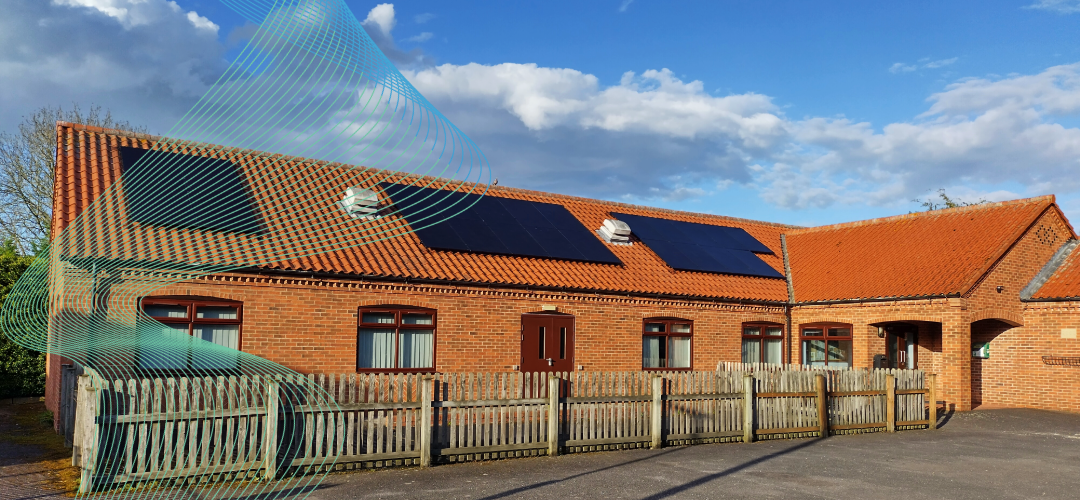
At Elements Green, we see community-scale solar as part of the same picture. Through our voluntary, discretionary NG+ Community Fund, which operates separately from the planning process for Great North Road Solar and Biodiversity Park (GNR), we support community-scale solar projects, most recently donating funds for solar panels on a village hall, helping to reduce energy costs, lower emissions and ensure more of the benefits of the energy transition are felt within local communities. The fund is designed to support projects that deliver lasting social, environmental and economic value in the areas connected to our developments. If approved, GNR is expected to provide around £1 million per year in community funding for local parishes for up to 40 years.
Education is also central to our skills work. Through EG Academy, our free, CPD-accredited learning platform launched at Nottingham Trent University, we provide courses covering solar, battery storage, biodiversity and careers in the energy transition. We also work with local colleges and partners to build knowledge and awareness of the skills the sector needs.
Looking ahead
If the pilot proves successful, the DfE hopes privately funded solar will become available to schools and colleges across England from the 2027-28 financial year. The model will require careful implementation and appropriate safeguards. But it could widen access to solar generation, reduce a significant and unpredictable cost for schools, and give a generation of pupils a working example of the energy transition on their own roof.