Discussions about solar and food security often begin with the question of farmland. It’s an important issue, and one that already has a substantial evidence base behind it.
In the UK, looking at Defra’s data reveals a more nuanced picture, shaped not only by land use but also by weather, productivity, supply chains and the resilience of the wider food system.
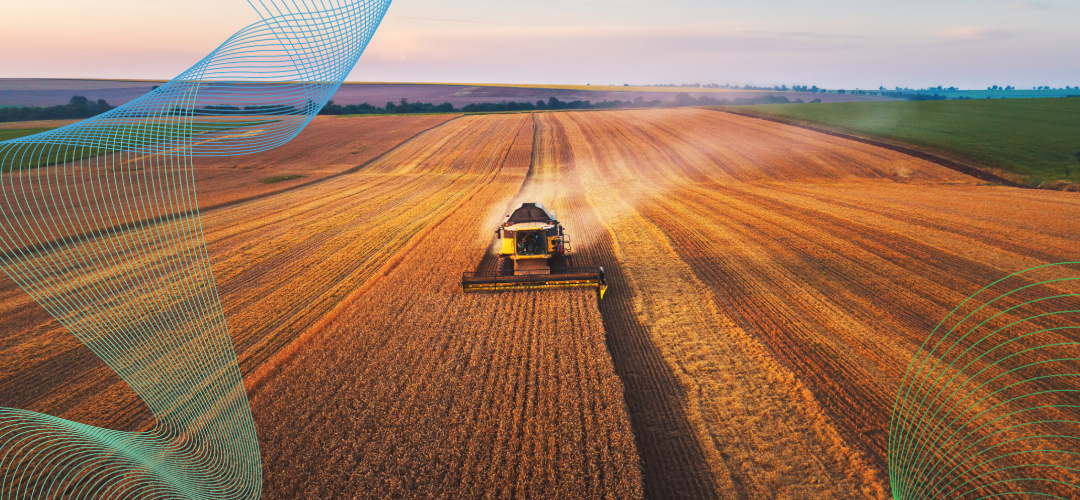
The UK’s utilised agricultural area (UAA), the land actually used for farming, was approximately 17 million hectares in 2024, covering around 69% of the UK’s land area. According to Defra’s Agriculture in the United Kingdom 2024 report, the UAA decreased by 1.5% between 2023 and 2024, continuing a gradual year on year decline. It remains within the broad range of 17 to 18 million hectares that Defra records as having held since 2000.
Defra’s latest annual figures show that the UAA increased slightly in 2025, from 16.760 million hectares in 2024 to 16.821 million hectares, an increase of 0.4%. Rounded, this remains around 17 million hectares and continues to account for 69% of the UK’s land area. The latest figures therefore do not show a continuing year-on-year fall in UAA during 2025.
The available data does not suggest a rapid or large-scale reduction in the amount of land available for farming.
Year-to-year swings in harvests are mostly a weather story
Recent headlines about falling crop production are real. Defra’s reporting identifies weather as a major factor affecting recent crop areas and yields, including difficult planting conditions in 2024.
England experienced its wettest 18-month period on record between October 2022 and March 2024, according to Met Office data cited within Defra’s reporting. That run of wet weather affected how much land could be planted and how well crops yielded.
The final accredited statistics in cereal and oilseed production in the United Kingdom 2024 show the 2024 UK wheat harvest fell by 20% on 2023, driven by an 11% decrease in planted area and a 10% decrease in yield.
Defra reports that the 2024 wheat crop suffered from wet planting conditions in winter and spring, which affected both area and yield. This provides important context for the fall in production without assuming that changes in the total amount of agricultural land were the cause.
Solar’s footprint is a different order of magnitude to agriculture
Set against the roughly 69% of UK land used for agriculture, solar’s current footprint is small.
Research published in Progress in Energy estimates that solar parks occupy around 0.06 to 0.07% of UK land area, and that even the most ambitious 2050 deployment scenarios would remain below 0.72%.
That is a projected upper scenario rather than a current figure, and it is important to distinguish between the two.
At a national level, solar occupies a very small proportion of land compared with agriculture.
Where the genuine nuance sits
None of this means every concern about solar and farmland is unfounded.
The Campaign to Protect Rural England (CPRE)’s July 2025 analysis indicated that a majority of England’s largest operational solar parks sit at least partly on productive farmland, including some higher-grade land.
That is a legitimate consideration within the planning process. However, it is also important to understand how agricultural land is classified and how solar schemes are designed in practice.
Separate peer-reviewed research published in 2026 provides a more detailed national picture. Researchers mapped 1,300 UK solar farms and found that Grade 3 was the predominant Agricultural Land Classification, accounting for 64% of solar farms, followed by Grade 2 at 17% and Grade 4 at 15%. Importantly, the researchers cautioned that the available national spatial data cannot reliably distinguish between Grade 3a and Grade 3b. This distinction matters because Grade 3a forms part of the UK’s Best and Most Versatile (BMV) agricultural land, while Grade 3b does not. Read the study in Ecological Solutions and Evidence and Defra’s guidance on Agricultural Land Classification.
Agricultural Land Classification (ALC) surveys rarely produce neat blocks of land that are entirely one grade. Individual fields can contain a mix of classifications, with pockets of Grade 1, 2 or 3a land sitting within larger areas of Grade 3b or lower-quality farmland. In these circumstances, drawing a solar layout that precisely excludes every small area of higher-grade land is not always practical.
In some cases, excluding isolated pockets of BMV land would leave small “islands” of farmland surrounded by infrastructure or solar arrays. Such areas can be difficult to access, cultivate and manage efficiently, reducing their agricultural usefulness even if they remain technically available for farming.
As a result, planning assessments typically look not only at whether BMV land is present within a site boundary, but also at its extent, distribution and agricultural significance in the context of the site as a whole. The issue is therefore often more nuanced than a simple distinction between sites that contain BMV land and those that do not.
Equally, the presence of some higher-grade land within a solar project does not necessarily mean that entire fields of the highest-quality farmland have been targeted. Many sites comprise a mosaic of land grades, and developers are generally expected to demonstrate that poorer-quality land has been prioritised where possible and that agricultural impacts have been minimised through site design.
This does not remove legitimate concerns about the cumulative loss of productive farmland, particularly in areas where large numbers of solar projects are proposed. However, it does highlight the importance of considering individual schemes on their merits rather than assuming that all hectares identified as containing BMV land represent the same level of impact on food production.
National land-use statistics do not resolve local questions about where individual sites are best located, nor should they be expected to. Planning decisions involve factors including grid capacity, land classification and local circumstances, which are assessed on a case-by-case basis.
How Germany balances solar and food production
The relationship between solar generation and agricultural land is being considered elsewhere in Europe too. Germany provides a useful comparison because, like the UK, it is expanding solar while considering how productive farmland should be protected.
Germany’s Federal Ministry of Agriculture explicitly recognises the potential competition between solar development and agricultural production. One response has been to support agrivoltaics, where farming and solar generation take place on the same land. Under Germany’s framework for qualifying agrivoltaic projects, solar infrastructure can account for no more than 15% of the agricultural area, leaving at least 85% available for continued agricultural use. Germany has also created a specific route for dual-use projects within its solar auctions: in the federal auction that closed in March 2026, 59 ‘special solar installations’, totalling 439 MW, secured contracts.
Germany also continues to develop conventional ground-mounted solar. Its Environment Agency estimates that around 52,000 hectares were occupied by ground-mounted solar at the end of 2025, including around 29,000 hectares of arable land. Even if all the additional ground-mounted solar Germany estimates could be required to 2040 were located on agricultural land, it calculates that this would require a maximum of around 1% of Germany’s 16.7 million hectares of agricultural land.
The German Environment Agency nevertheless recommends protecting higher-quality arable land where possible, in part to safeguard food production. It advocates greater use of previously developed or lower-value land and sees agrivoltaics as one way of using land more efficiently. This is similar in principle to the UK planning approach, which states that where agricultural land is needed for solar development, poorer-quality land should be preferred to higher-quality land. Where Best and Most Versatile agricultural land is proposed, developers are expected to justify its use and consider how impacts can be avoided or mitigated.
Agrivoltaics may offer further options for some UK sites, but it is not yet a straightforward substitute for conventional solar development. Systems can require different mounting structures, greater spacing and layouts that allow agricultural machinery, livestock or crops to operate alongside electricity generation. These design choices can affect costs, generating density and project economics.
Germany has created specific policy support for some dual-use solar projects. The UK is at an earlier stage. The Government’s Solar Roadmap describes agrivoltaics as a rapidly developing industry and says it is working to understand the opportunities. It also commits Government and industry to exploring future research and demonstration opportunities, subject to Defra’s evidence review.
This makes agrivoltaics an important part of the discussion, rather than a single answer to the question of solar and food production. The UK already has planning protections for higher-quality agricultural land, while the proportion of national land currently occupied by solar remains small. The experience in Germany shows how dual-use technologies could add another option as the technology, evidence and commercial models develop.
What this means for food security
Food security depends on more than the total amount of agricultural land. It is also influenced by weather resilience, soil health, water availability, energy costs, supply chains and the ability of farms to adapt to a changing climate.
The 2026 growing season illustrates the influence of weather from the opposite direction to 2024. Following prolonged dry conditions and a series of heatwaves in the UK, the Environment Agency’s National Drought Group reported on 21 July that farmers had begun harvesting early and warned that cereal yields were expected to be lower than previously anticipated. At that point, England had received only 3% of its long-term average July rainfall, with parts of the south and east recording no rainfall during the month to date.
Early AHDB harvest data, covering harvests to 27 July 2026, estimated average wheat yields at 6.8 tonnes per hectare. This compared with 7.2 tonnes per hectare in 2025 and a ten-year average of 7.9 tonnes. AHDB emphasised that these figures were provisional and that performance varied substantially between farms, regions and soil types.
Defra’s Food Statistics Pocketbook highlights how food security challenges vary across different sectors of agriculture. While cereal production has fluctuated over the last decade, largely in response to weather conditions, UK cereal output has remained comparatively resilient relative to several other food categories.
The evidence also suggests the discussion is more nuanced than a simple choice between food production and renewable energy. Responsible land-use decisions involve balancing a range of factors including food production, energy security, climate resilience, biodiversity, flood management and the long-term stewardship of land.
The evidence reviewed here does not identify solar land take as a leading national driver of recent fluctuations in UK food production.
Solar parks are also not necessarily a permanent change to land use. Many are granted time-limited planning permissions, often around 30 to 40 years, after which decommissioning and land restoration requirements may apply. In some cases, agricultural activities such as grazing can continue during operation, although this varies by site and should be assessed on its own merits.
Changes in cultivation and vegetation management during a solar park’s operating life can affect soil conditions over time. Outcomes depend on the site, its previous agricultural use and how the land is managed. This is explored in more detail in our article on soil health and solar parks.
The debate about how the UK grows and secures its food is a real one, and it deserves to be informed by the evidence already published.
Taken together, the evidence suggests that land area is only one part of the relationship between solar development and food security. Weather resilience, agricultural productivity, soil and water conditions, supply chains, land quality and project siting all matter. Against that wider context, the land currently used for solar generation remains a relatively small component of the national picture, while experience from Germany shows different ways in which the relationship between agriculture and solar is being addressed.