Solar parks currently occupy between 0.06% and 0.07% of UK land. Under the most ambitious deployment scenario modelled by Lancaster University, UK, solar parks could occupy up to 0.72% of UK land area by 2050. The figure remains well below 1%, even under the most extensive future deployment pathways considered by researchers.
Those numbers come from a Lancaster University study published in Progress in Energy in April 2025, the most comprehensive analysis of UK solar land use yet conducted. Researchers manually digitised satellite imagery from 1,088 solar parks across the UK, finding that between 15,580 and 17,364 hectares are currently occupied by solar developments. It is the first UK-wide estimate based on direct observation rather than extrapolation from sample sites.
The finding challenges the assumption that solar is already consuming substantial amounts of land and will continue to expand indefinitely. The evidence points clearly in a different direction.
Why future land requirements remain low
The Lancaster University study found that to meet the ambitious 50GW target for 2030, assuming the current mix of rooftop and ground-mounted solar continues, just 0.22% of additional land would need to host solar generation technology. To meet the highest ambition target of 90GW by 2050, 0.39% of land not already hosting a solar farm would be required. Even in the most conservative scenario, where all future solar is ground-mounted rather than a mixture of ground-mount, rooftop and floating solar, the figure reaches just 0.72%.
Several factors keep land requirements modest. Solar panels continue to become more efficient, generating more electricity from the same area. An increasing proportion of new capacity is being installed on rooftops, industrial buildings and commercial sites. And current deployment pathways already reflect planning constraints and practical limits on suitable land.
This means solar’s footprint does not grow in proportion to installed capacity. Even under ambitious scenarios, land requirements remain comparatively small.
Where solar locates, and why
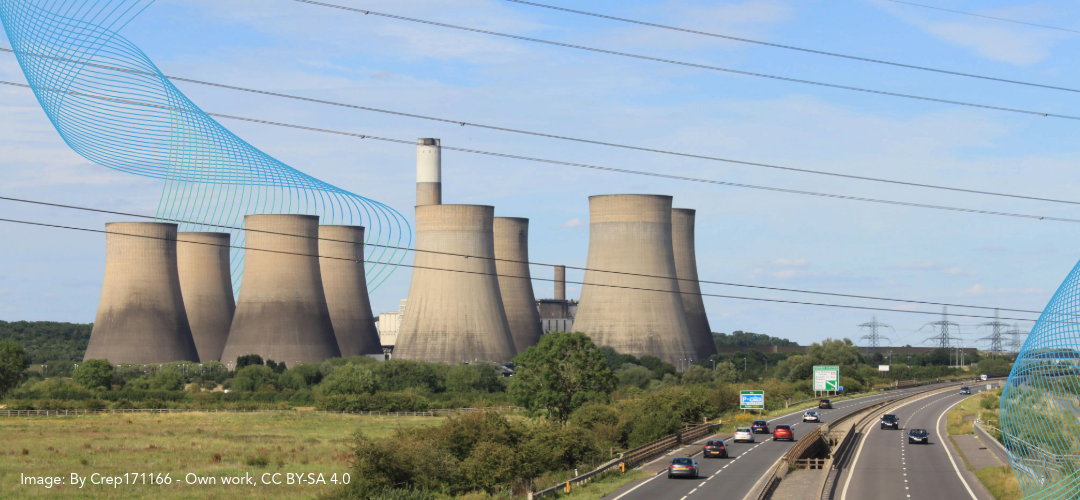
The distribution of solar is not random. Sites tend to cluster where grid infrastructure already exists, often because of the legacy of fossil fuel power generation. Former coal-fired power stations and other energy infrastructure sites are often associated with major substations and transmission connections, making them attractive locations for utility-scale solar and battery storage.
Connecting new renewable energy projects to the electricity network can be one of the biggest challenges facing development. Building generation far from existing grid infrastructure may require additional reinforcement works, lengthy approval processes and significant investment. Locating projects close to existing transmission assets can help reduce those constraints and accelerate deployment.
This pattern is already visible across the UK. One Earth Solar Park, a 740MW project in Nottinghamshire, will connect to the grid at High Marnham, the site of a former coal-fired power station. In County Durham, a solar park near Seaham was recently approved on land within 100 metres of the former Dawdon Colliery, with the local councillor noting that the area had experienced 100 years of coal extraction and welcoming the shift to clean energy.
Our proposed UK, Great North Road Solar and Biodiversity Park (GNR), for example, connects to National Grid’s existing Staythorpe 400kV substation in Nottinghamshire, located within a region that has long played a significant role in power generation.
This is a subject we will explore in more depth in a future article, looking specifically at how the UK’s energy geography, shaped by decades of fossil fuel infrastructure, is now informing where the next generation of clean energy projects is being built.
Putting the numbers in context
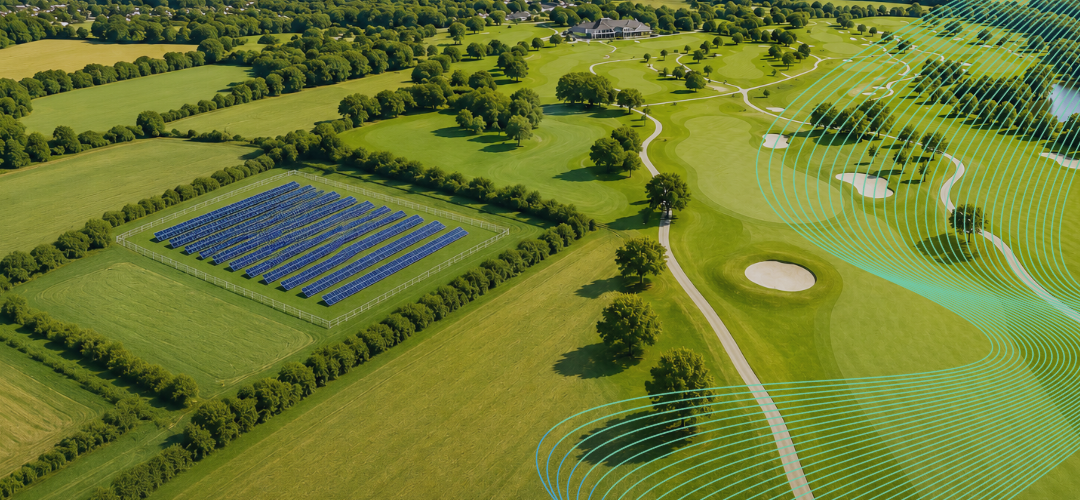
Comparisons help illustrate scale. According to Custodian Golf, using Ordnance Survey data updated in 2025, golf courses in Great Britain cover approximately 118,100 hectares, equivalent to around 0.56% of Great Britain’s land area. That is about eight times more land than the UK’s solar parks occupy today.
The UK is also home to around 3,100 golf courses, the second-highest number of any country in the world after the United States. A peer-reviewed study published in Environmental Research Communications in February 2025 found that, in countries including the United Kingdom and United States, substantially more land is devoted to golf courses than to utility-scale solar energy. The researchers concluded that comparisons of this kind provide useful context for debates about the land requirements of renewable energy.
Importantly, the authors do not advocate replacing golf courses with renewable energy projects, nor do we. Golf courses provide recreation, green space and, in many cases, valuable wildlife habitat. The comparison is intended simply to put solar’s land footprint into perspective.
Meanwhile, the Department for Energy Security and Net Zero (DESNZ) estimates that ground-mounted solar panels covered around 21,200 hectares at the end of September 2024, equivalent to approximately 0.1% of total UK land area.
Agriculture occupies around 69% of the UK’s land area, according to Defra’s most recent agricultural land use statistics. Against those benchmarks, solar remains a comparatively small land use. It is not projected to approach agriculture’s share of land use under any current technology, planning framework, or deployment pathway.
Germany tells a similar story
Germany has one of Europe’s most ambitious solar programmes. By the end of 2024, Germany had 99.3GW of installed solar capacity, with ground-mounted installations representing around one-third of newly added capacity.
By the end of 2024, ground-mounted solar installations in Germany covered approximately 45,200 hectares, according to RWE’s fact-checking analysis citing the latest Zentrum für Sonnenenergie- und Wasserstoff-Forschung Baden-Württemberg (ZSW) data. PV systems account for just 0.1% of Germany’s 11.7 million hectares of arable land. For comparison, golf courses in Germany occupy around 48,000 hectares.
In other words, golf courses in Germany cover more land than all of Germany’s ground-mounted solar. Solar parks, the RWE analysis notes, are often located on land with lower agricultural productivity or on sites that are difficult to cultivate.
This echoes the findings of the Environmental Research Communications study, which found that in several countries, including the UK and Germany, golf courses occupy more land than wind or solar energy developments, highlighting the importance of considering land use in its broader context.
Germany’s target of 215GW of installed solar capacity by 2030 will require further land, but the trajectory remains the same: solar delivers substantial energy output while occupying a relatively small share of land.
The land is not lost permanently
A further point is permanence. Solar developments in the UK are generally granted planning permission for a fixed period, typically between 30 and 40 years. Planning conditions usually require sites to be decommissioned and restored in accordance with agreed restoration measures at the end of that period.
The Lancaster University study found that around 95% of the land currently used by UK solar farms was formerly agricultural. About two thirds of that was formerly arable land, and about a third improved grassland. The researchers also noted that existing national agricultural land classification datasets have limitations and may not provide sufficient accuracy for detailed planning decisions. Each solar proposal is therefore assessed on its own evidence and circumstances, including consideration of agricultural land quality and efforts to minimise impacts on the most productive farmland, such as Grade 1 and Grade 2 land. Solar developments represent a temporary change in land use and are typically subject to a defined restoration framework and timeline.
What this means in practice
Proposed sites sit within a national land-use picture that is already small in scale and projected to remain so, even under ambitious deployment pathways.
That does not mean individual projects should avoid scrutiny. Every development should be assessed on its local impacts and merits. But the wider national picture matters. Solar’s land requirement is measured in fractions of a percent, not in wholesale landscape change.
The evidence from both the UK and Germany points to the same conclusion: solar delivers significant amounts of clean electricity while occupying a relatively small share of land, and that share remains limited even under the most ambitious future deployment scenarios.